U.N.-Health-y Choices?
Ten years ago, I wrote an article titled The Next UN Secretary General will have Little/No Background in Health, looking at the resumes of the dozen leading candidates to fill that office. Today, the UN is in the midst of selecting a new Secretary-General to succeed António Guterres on January 1st, 2027, less than three months from now, and the situation, unfortunately, is exactly the same. Whoever succeeds Mr. Guterres will have no meaningful experience in global health.
Why This Matters
The US withdrawal from the UN’s WHO (the World Health Organization) and UNFPA (the United Nations Population Fund), along with the concurrent dismantling of USAID (the US Agency for International Development), have seriously diminished global funding to address some of the world’s most urgent public health needs. These organizations are engaged in essential services on maternal and infant health, prevention of and response to epidemics ranging from COVID-19 to Ebola, provision of clean water, eradication of crippling diseases like malaria, vaccinating children against a host of preventable diseases, and so much more. [ 1 ]
In concrete terms, the US had been contributing 18% of WHO’s budget. After withdrawing that support, the agency eliminated nearly 3,000 WHO positions or 22% of the agency’s staff. For UNFPA, the US had provided 17% of contributions. [ 2 ]
In addition, the US has decimated the CDC (Centers for Disease Control and Prevention), which has played a significant role in global health. In particular, the CDC’s programs for Immunization and Respiratory Diseases saw a 16% cut in employees, the Emerging and Zoonotic Infectious Diseases program saw a 17% staff cut, and the Global Health Center lost 28% of its employees. [ 3 ] To see how these cuts have affected the US response to the most recent Ebola outbreak, see this detailed comparison to two earlier outbreaks here: [ 4 ].
These cuts have occurred at a time when there are
Notable cholera outbreaks in Afghanistan, DRC, Yemen and a dozen other counties.
Recurrent outbreaks of Ebola in the Democratic Republic of the Congo, and now even for the first time, in Kenya.
Likely climate and seasonal related spikes in West Nile, Dengue, COVID-19, avian A(H5N1) and non-avian influenza, and other diseases
…and, as I write this, the possibility of a lab-related release of pneumatic plague in Russia.
And the Nominees Are…
Here are the current contenders for Secretary-General. There were originally nine nominations, however Virginia Gamb and Michelle Bachelet Jeria have withdrawn from consideration. Feel free to double-check my characterizations of their experience by reading their CVs. [ See note 5 ]
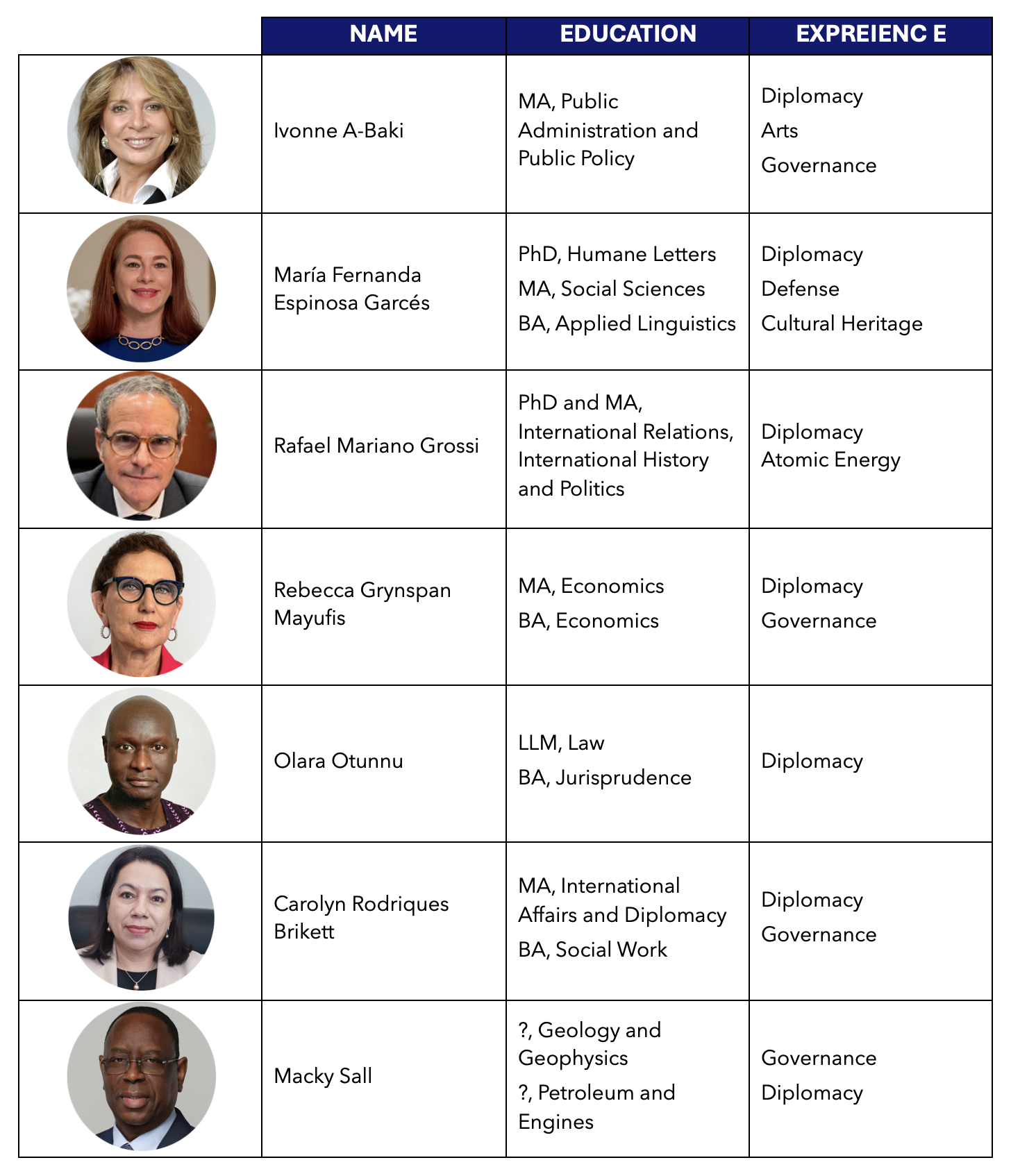
In all fairness, Ivonne A-Baki’s resume does mention one health-related experience, saying she was “Founder, Beyond Boundaries Foundation, which eradicated river blindness in Ecuador and now expands public health education.” [ 6 ] However, polling on September 19th and October 7th by the members of the Security Council ranks her as least likely to be selected. [ 7 ]
Also to be noted, it is possible that none of the current candidates will be selected. That might open the door for someone with meaningful global health credentials, though it seems more likely that someone with business/financial experience would be put forward. The US appears to oppose all of the current candidates [ 8 ] and is likely to support someone with administrative rather than leadership credentials. It is also possible that no one will be approved as Secretary-General by the first of the year, a situation that the UN’s rules didn’t anticipate and don’t cover. As the article at note 8 reports, John Bolton, former US representative to the UN, believes “the administration may not mind the top slot going unfilled for a while.”
Conclusion
The number of violent conflicts worldwide is at its highest level since WW-II. [ 9 ] At the same time, the number of climate- and weather-related disasters is rising steeply. [ 10 ] Together these provide a remarkably fertile condition for unprecedented health crises, everything from large-scale starvation, zoonotic disease outbreaks, and global pandemics.
As my previous article concluded:
The question then is does the secretary general actually need to be somehow qualified in the field to lead the UN’s efforts to improve global health and fight disease? No…but it would be welcomed.
Surely anyone in that office will be well-informed and ably-advised, and they will most certainly have the rhetorical skills to explain to the world the details and implications of any such crisis should it arise. But just as surely, if that person had credentials in public health, in medicine, or in biomedical research, their statements would have an added credibility and their directions an added authority.
NOTES
[ 1 ]
In all, during the current Administration, the US has withdrawn from 31 UN agencies, many related to the monitoring and mitigation of climate change, a factor tied to many health outcomes. See https://betterworldcampaign.org/budget/breaking-down-the-31-un-agencies-impacted-by-us-withdrawal
For a detailed look at WHO’s work, see A Global Health Strategy for 2025–2028 (https://www.who.int/about/general-programme-of-work/fourteenth)
To see UNFPA’s work, see https://www.unfpa.org/what-we-do
[ 2 ]
https://news.northeastern.edu/2025/01/23/us-withdrawn-from-who/
https://www.kff.org/global-health-policy/the-u-s-government-and-the-world-health-organization/
https://www.kff.org/global-health-policy/unfpa-funding-and-kemp-kasten-an-explainer/
[ 3 ]
https://www.nytimes.com/2026/09/26/health/cdc-staff-cuts-rfk-jr.html
[ 5 ]https://www.un.org/en/sg-selection-and-appointment
[ 6 ]
I can not find a website for this organization. It may not still be in existence.
[ 8 ]
https://www.politico.com/news/2026/10/09/trump-un-chief-candidates-01115653
[ 9 ]
https://academic.oup.com/jpr/article/63/4/705/8703754?login=false
[ 10 ]
https://www.independent.co.uk/climate-change/news/weather-disasters-un-climate-change-b1911729.html
and
https://www.unep.org/news-and-stories/story/climate-crisis-explained-seven-graphs
IMAGES
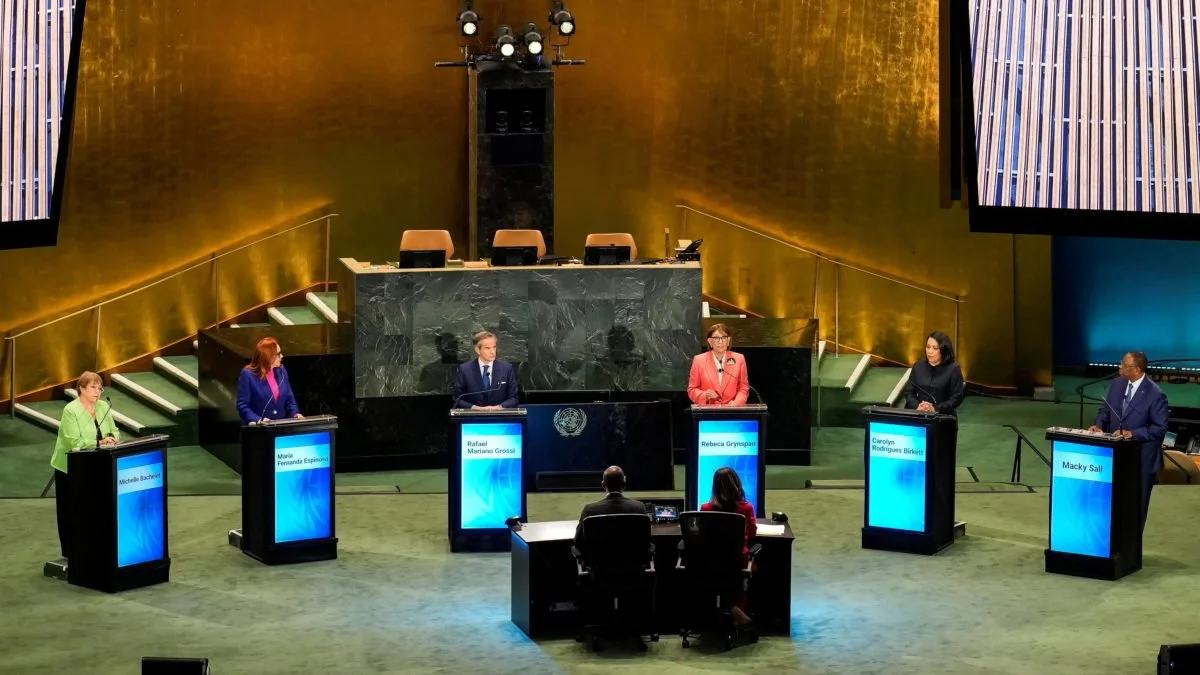
Candidates’ debate at a town hall on July 23rd. Uncredited, but likely: UN Photo / Eskinder Debebe.
https://www.pbs.org/newshour/world/who-will-be-the-uns-next-secretary-general-what-to-know-about-the-selection-process
Photo of the Secretary-General’s nameplate. Credit, UN Photo/Loey Felipe https://news.un.org/en/story/2026/04/1167323